New pamban bridge, Tamilnadu: india’s first vertical lift railway sea bridge – history, engineering, features and tourism guide
Few journeys in India compare to looking out a train window and seeing nothing but blue ocean on both sides. For over a century, the iconic Pamban Bridge offered travelers and pilgrims that exact thrill as they crossed the Palk Strait into Rameswaram Island.
Today, that legacy continues with a striking modern upgrade: the New Pamban Railway Bridge.
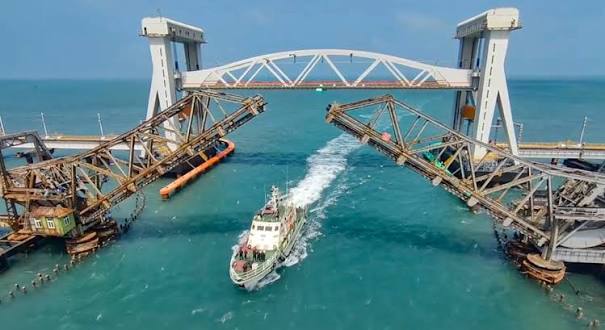
Standing side-by-side with its historic predecessor in Tamil Nadu’s Ramanathapuram district, this structure is officially India’s first vertical lift railway sea bridge. Built to withstand harsh marine weather while letting ships pass underneath, it bridges the gap between mainland India and Rameswaram—and between early 20th-century engineering and modern railway innovation.
Whether you are a railway enthusiast, a photographer, or planning a pilgrimage to Rameswaram, here is everything you need to know about the New Pamban Bridge, how it works, and how to experience it.
From 1914 to Today: Why a New Bridge Was Needed
To appreciate the new bridge, you have to look at the original one. Opened in 1914 during British rule, the old Pamban Bridge was an engineering marvel of its time. Before it existed, reaching Rameswaram from mainland Tamil Nadu required a slow ferry ride. The railway changed everything, opening up trade and making the sacred island accessible to millions of pilgrims.
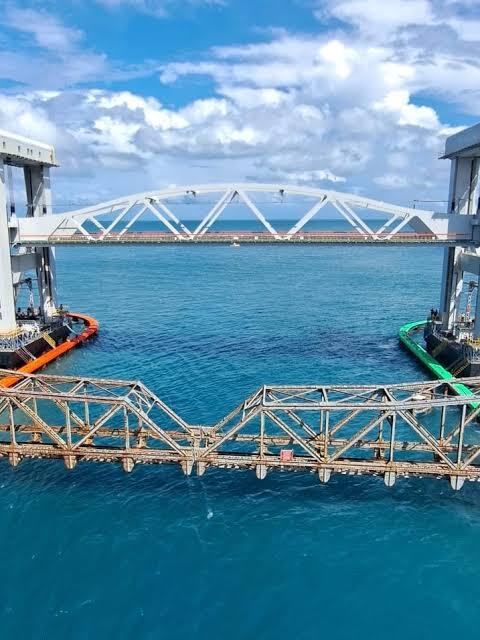
The old bridge was famous for its Scherzer rolling lift span—a manual, scissor-like mechanism where two halves of the track tilted upward like a drawbridge to let ships through.
For more than 100 years, it endured relentless salt spray, fierce winds, and even the catastrophic 1964 Rameswaram cyclone (which washed away an entire passenger train nearby, though the bridge’s pillars miraculously survived). By late 2022, however, a century of saltwater corrosion had taken its toll. In December 2022, Indian Railways suspended train services across the old bridge due to safety concerns, temporarily cutting off direct rail access to the island.
Sanctioned in 2019 and executed by Rail Vikas Nigam Limited (RVNL), the New Pamban Bridge was built to replace that aging lifeline with a structure capable of handling heavier, faster trains for the next century. On April 6, 2025, Prime Minister Narendra Modi officially inaugurated the bridge and flagged off the Rameswaram–Tambaram Express, restoring direct rail connectivity to the island.
What Makes It Special? The Vertical Lift Mechanism
Unlike fixed bridges, a sea bridge across a busy shipping channel has to solve a tricky problem: how do you keep trains running at sea level without blocking tall boats and coast guard vessels?
While the 1914 bridge rolled open like a drawbridge, the New Pamban Bridge operates like a giant elevator.
-
The Lift Span: A massive 72.5-metre central steel section sits between twin towers.
-
The Clearance: Using an electromechanical system balanced by heavy counterweights, the entire 72.5-metre track section rises straight up—up to 17 metres above its normal position—while staying completely horizontal.
-
Smooth Operations: Once a ship clears the navigational channel, the span lowers back into place, locks securely, and undergoes automated safety checks before trains resume crossing.
Quick Facts & Technical Specifications
Built to Survive the Sea: Engineering & Materials
Building a 2-kilometre bridge in open, turbulent waters is no small feat. Engineers had to battle unpredictable sea currents, high-velocity winds, and a cyclone-prone zone. To assemble the massive central lift span without disrupting marine traffic, RVNL used a specialized auto-launching technique, sliding over 1,400 tonnes of fabricated steel smoothly from pier to pier.
Because salty sea air eats through regular steel within years, the bridge was constructed using heavy-duty marine-grade protections:
-
Stainless steel reinforcement in the concrete substructure to prevent internal rusting.
-
Fully welded joints rather than traditional rivets, reducing weak spots where moisture can trap.
-
Polysiloxane protective coatings and high-grade marine paint designed to resist UV rays and salt corrosion for decades with minimal maintenance.
Even better, the bridge is future-proofed. While it currently carries a single electrified railway track, the concrete piers beneath it were built wide enough to support a double-track line whenever passenger demand requires it.
Old vs. New Pamban Bridge: At a Glance
Visiting Guide: Nearby Attractions & Travel Tips
For travelers, the best way to experience the New Pamban Bridge is simply by riding a train across it. Direct trains connect Rameswaram with Chennai, Madurai, Tiruchirappalli, and Kanniyakumari. If you are driving, the parallel Annai Indira Gandhi Road Bridge (Pamban Road Bridge) offers a fantastic vantage point to view both the new vertical-lift structure and the historic 1914 railway bridge side by side.
Top Places to Visit Nearby
-
Ramanathaswamy Temple: Just a short drive from the bridge, this famous Jyotirlinga shrine is renowned for having the longest pillared corridors of any Hindu temple in India and 22 sacred water tanks (theerthams).
-
Dhanushkodi: Located at the southeastern tip of Pamban Island, this eerie, breathtaking “ghost town” was destroyed in the 1964 cyclone. Drive down the narrow strip of land to Arichal Munai, where the calm waters of the Bay of Bengal meet the rougher waves of the Indian Ocean.
-
Dr. A.P.J. Abdul Kalam National Memorial: Located in Pei Karumbu, this dignified memorial honors India’s “Missile Man” and former President, who was born and raised in Rameswaram.
-
Agni Theertham: Situated right outside the east gate of Ramanathaswamy Temple, this calm stretch of beach is where pilgrims take a holy dip at sunrise before entering the temple.
Practical Travel Tips
-
Best Time to Visit: October to March brings pleasant coastal breezes and comfortable daytime temperatures (22°C–30°C). April and May are intensely hot and humid, while October to December sees northeast monsoon rains and stronger winds.
-
Safety Rules: Remember that the New Pamban Bridge is a high-security, active railway zone—walking on the railway tracks is strictly prohibited. Stick to the pedestrian walkways on the nearby Pamban Road Bridge or designated coastal viewpoints near Mandapam and Pamban village for photography.
-
How to Reach:
-
By Rail: Book a direct train terminating at Rameswaram (RMM) to cross the bridge.
-
By Air: The nearest airport is Madurai (IXM), roughly 175 km (about 3.5 hours by road) away.
-
By Road: Well-maintained highways (NH 87) connect Madurai and Ramanathapuram directly to Rameswaram via the Pamban Road Bridge.
-
Frequently Asked Questions
Can tourists walk on the New Pamban Bridge?
No. It is an active, restricted railway bridge without a public footpath. Tourists can view and photograph it safely from the parallel Pamban Road Bridge or from the shoreline at Mandapam and Pamban.
Is the New Pamban Bridge India’s longest sea bridge?
No. At 2.08 km, it is not the longest (a title held by the 21.8 km Mumbai Trans Harbour Link / Atal Setu). Its claim to fame is being India’s first vertical lift railway sea bridge.
How long does it take for the bridge to lift for a ship?
Under standard railway operating procedures, the electromechanical lifting mechanism can raise the 72.5-metre span to its full 17-metre height in just a few minutes, though total marine transit time includes signaling and safety clearance checks.
What happened to the old 1914 Pamban Bridge?
Train operations on the old bridge permanently ceased in December 2022. Indian Railways has announced plans to preserve portions of the historic Scherzer span as a heritage monument to honor its century-long service.