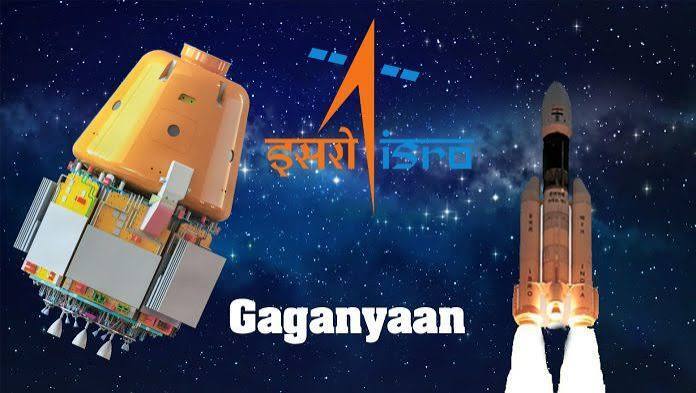
Gaganyaan mission: india’s first human spaceflight mission
Over the past few decades, India has pulled off some remarkable feats in space. From launching commercial satellites and landing on the Moon’s south pole to reaching Mars on our very first attempt, ISRO has firmly put India on the global space map.
Now, the agency is gearing up for its biggest leap yet: sending Indian astronauts into space on an Indian-made rocket.
This mission is called Gaganyaan, and it marks a completely new chapter for the country. Launching a satellite is hard enough, but putting human beings on top of a rocket changes everything. The spacecraft has to act like a mini-Earth—supplying oxygen, regulating cabin pressure and temperature, shielding the crew from harsh radiation, and surviving the fiery plunge back through the atmosphere.
Here is a complete breakdown of the Gaganyaan mission, how it works, who is flying, and where the project stands right now.
What Exactly Is the Gaganyaan Mission?
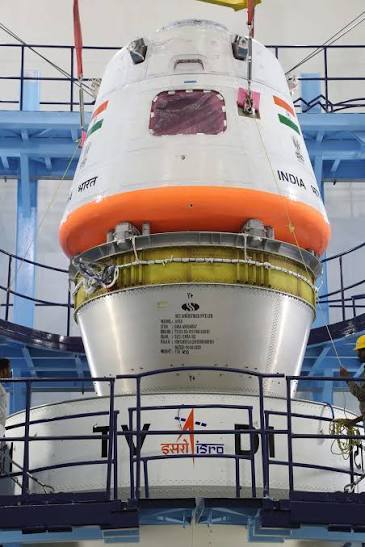
Derived from the Sanskrit words Gagan (sky) and Yaan (vehicle), Gaganyaan is India’s first indigenous human spaceflight programme.
The goal is straightforward on paper, though massive in execution: launch a crew of three Indian astronauts—called Gaganyatris—into Low Earth Orbit (about 400 kilometres above Earth) for a short-duration mission, and bring them back safely.
If successful, India will join an elite club of nations (alongside the US, Russia, and China) capable of independently launching humans into space. More importantly, this mission lays the groundwork for India’s long-term ambitions, including building our own space station.
When Was It Announced?
Prime Minister Narendra Modi first announced the Gaganyaan mission during his Independence Day address from the Red Fort on 15 August 2018.
While the original hope was to launch within a few years, human spaceflight doesn’t allow for shortcuts. Because astronaut safety comes before deadlines, ISRO spent the subsequent years collaborating with defence organisations, research labs, and private industries to rigorously test every bolt, parachute, and life-support system before putting a human life on the line.
Core Objectives of the Mission
Gaganyaan isn’t just about planting a flag in orbit; it’s about building an entire ecosystem from scratch. Its main goals include:
-
Demonstrating Indigenous Capability: Proving India can design, launch, operate, and safely recover a crewed spacecraft on its own.
-
Mastering Life-Critical Tech: Developing everything from human-rated rockets and thermal shields to Environmental Control and Life Support Systems (ECLSS) and emergency escape mechanisms.
-
Conducting Microgravity Research: Giving Indian scientists a chance to run biological, physical, and material experiments in conditions impossible to replicate on Earth.
-
Building a Stepping Stone: Testing the foundational technologies needed for the upcoming Bharatiya Antariksh Station and future lunar landings.
The Rocket: Human-Rated LVM3 (HLVM3)
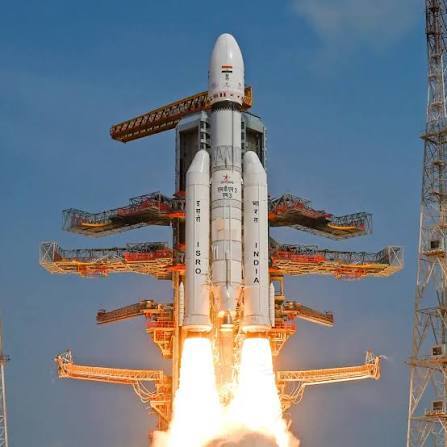
To carry astronauts, ISRO couldn’t just use an off-the-shelf rocket. They took their heaviest, most reliable launch vehicle—the LVM3 (formerly GSLV Mk III)—and upgraded it to meet strict human-safety standards. The result is the HLVM3.
It relies on a three-stage propulsion setup:
-
Two HS200 solid rocket boosters for the initial heavy lift off the launchpad.
-
An L110 liquid core stage to sustain the climb.
-
A C32 cryogenic upper stage to place the spacecraft precisely into orbit.
Sitting right at the top is a vital addition: the Crew Escape System (CES). If anything goes wrong with the rocket during liftoff or ascent, high-powered solid motors fire instantly to pull the astronaut capsule away to safety.
Inside the Gaganyaan Spacecraft
The spacecraft itself—called the Orbital Module—is split into two distinct sections:
-
The Crew Module: This is the astronauts’ living quarters and cockpit. It is pressurized to Earth-like conditions and packed with navigation controls, communication gear, and life-support systems. Its outer shell is covered in a specialized Thermal Protection System to survive the extreme heat of atmospheric re-entry.
-
The Service Module: Attached beneath the Crew Module during orbit, this unpressurized section acts as the powerhouse. It houses the propulsion engines for orbital manoeuvres, electrical power systems, and thermal management. Just before the capsule heads back to Earth, the Service Module detaches and burns up in the atmosphere.
Meet Vyommitra: The Robot Flying First
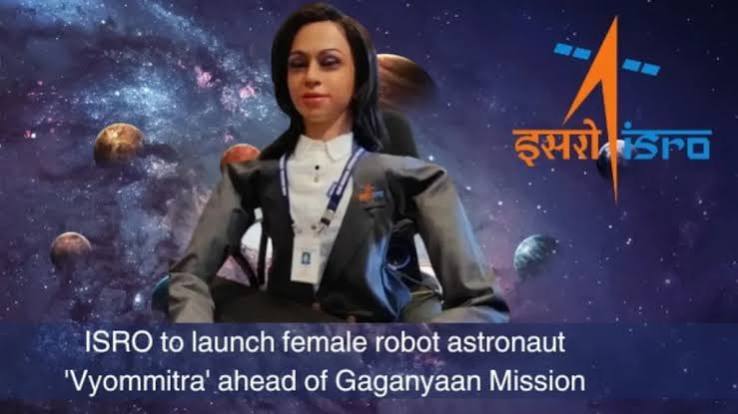

Before human astronauts strap in, ISRO is sending up Vyommitra (from Vyoma, meaning space, and Mitra, meaning friend)—a female-looking half-humanoid robot.
Vyommitra isn’t just a dummy passenger. She is built to mimic human functions inside the cabin: reading control panels, operating switches, monitoring air quality and cabin pressure, and communicating with mission control. Flying her on uncrewed test missions lets engineers see how the spacecraft behaves under real flight conditions without risking human lives.
Who Are the Selected Astronauts?
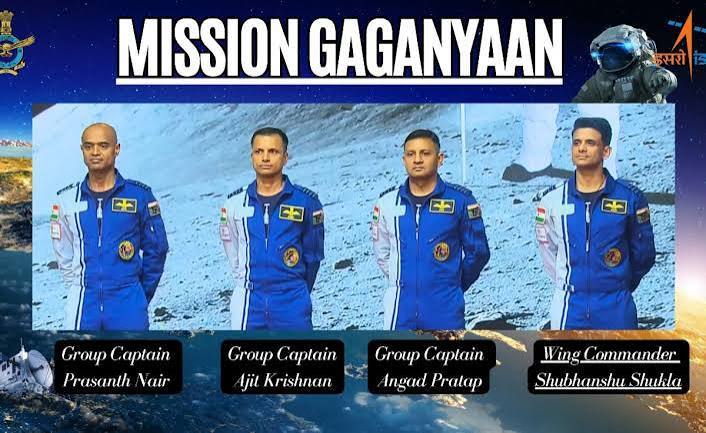
In February 2024, ISRO revealed the four Indian Air Force test pilots chosen to be India’s first Gaganyatris:
-
Group Captain Prasanth Balakrishnan Nair
-
Group Captain Ajit Krishnan
-
Group Captain Angad Pratap
-
Group Captain Shubhanshu Shukla
All four completed generic spaceflight training in Russia before returning to Bengaluru for intensive, mission-specific training—covering everything from simulator drills and survival training to physical conditioning.
Shubhanshu Shukla’s Head Start on the ISS
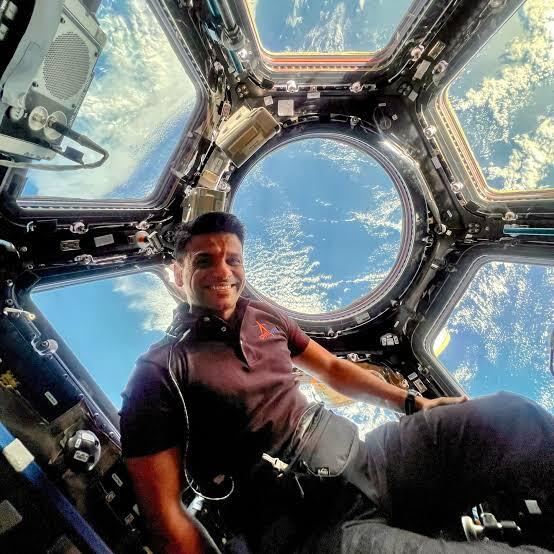
Ahead of Gaganyaan’s crewed launch, Group Captain Shubhanshu Shukla made history in 2025 by flying to the International Space Station (ISS) aboard Axiom Mission 4. While separate from Gaganyaan, the flight made him the first Indian on the ISS and the second Indian in space after Rakesh Sharma in 1984—giving ISRO invaluable, real-world orbital experience.
How Will the Crew Return Safely?
Coming home is often the trickiest part of spaceflight. Once the mission wraps up, the Crew Module separates from the Service Module and plunges back into Earth’s atmosphere.
After enduring intense friction and heat, a complex sequence of 10 parachutes (across four different types) deploys in stages to slow the capsule down from supersonic speeds to a gentle descent. The module will splash down in designated sea waters—typically the Bay of Bengal or the Arabian Sea—where Indian Navy ships and recovery teams will be waiting to retrieve the capsule and the crew.
Key Milestones and Tests Completed So Far
ISRO has been steadily ticking off major qualification tests to prove the hardware works:
-
TV-D1 Test (October 2023): Successfully tested the Crew Escape System mid-flight, proving the capsule can safely eject from a malfunctioning rocket.
-
IADT-01 (August 2025): The first Integrated Air Drop Test, where an IAF Chinook helicopter dropped a dummy capsule to test parachute deployment.
-
IADT-02 (April 2026): A heavy-duty test dropping a 5.7-tonne simulated Crew Module from 3 km up over the sea. All 10 parachutes deployed cleanly, and the Navy successfully recovered the capsule.
-
Main Parachute Drop Test (July 2026): Validated the structural strength of the main parachutes under peak flight loads.
Where Does the Mission Stand in Late 2026?
As of November 2026, hardware development is largely complete. According to Department of Space updates from August 2026, ground testing for all propulsion stages and structures of the HLVM3 rocket is finished.
The immediate focus is on the Gaganyaan G1 mission—the first uncrewed orbital flight carrying Vyommitra, targeted for the final quarter of 2026. Two more uncrewed flights will follow to verify every system in full flight configuration before ISRO clears the vehicle for human passengers. As always with spaceflight, exact launch dates remain fluid and strictly dependent on safety validations.
Budget and Long-Term Vision
In September 2024, the Union Cabinet expanded the scope of the programme, approving a total budget of roughly ₹20,193 crore covering eight missions.
This funding goes well beyond the first crewed flight. It directly feeds into India’s broader roadmap for space exploration:
-
Bharatiya Antariksh Station (BAS): India’s own five-module space station, with the first module (BAS-01) paving the way for full operations by 2035.
-
Indian Lunar Landing: A national target to land an Indian astronaut on the Moon by 2040.
Gaganyaan vs. Chandrayaan vs. Mangalyaan
It is easy to mix up ISRO’s flagship names, though each serves a completely different purpose:
| Mission | Primary Focus | Type of Flight |
| Chandrayaan | Exploring the Moon (orbiters, landers, rovers) | Uncrewed / Robotic |
| Mangalyaan | Studying Mars from orbit | Uncrewed / Robotic |
| Gaganyaan | Sending astronauts to Low Earth Orbit and back | Human Spaceflight |
Quick Facts & FAQs
How many astronauts will fly on the first crewed Gaganyaan mission? The spacecraft is designed to carry up to three astronauts into a 400-km Low Earth Orbit.
Why doesn’t ISRO just launch the astronauts right away? Human-rating a rocket requires near-zero margin for error. Every escape motor, heat shield, and parachute must be tested repeatedly in uncrewed flights before astronauts board.
Where will the capsule land? Unlike Soyuz capsules that land on solid ground, Gaganyaan is designed for an ocean splashdown in Indian waters, where the Indian Navy will handle recovery.
What happens after Gaganyaan? The technology and operational experience gained from Gaganyaan will directly support the construction of the Bharatiya Antariksh Station by 2035 and future crewed Moon missions.
Gaganyaan represents a defining moment for Indian science and engineering. When the HLVM3 finally lifts off with Indian astronauts strapped inside, it won’t just be a historic broadcast for millions watching at home—it will mark India’s arrival as a self-reliant spacefaring nation ready for the next frontier.