Jnanpith award: history, winners, selection process and importance of india’s most prestigious literary award
India’s literary landscape is remarkably diverse, stretching from ancient Sanskrit classics to modern masterpieces in Malayalam, Tamil, Hindi, Bengali, Kannada, and dozens of other regional tongues. While the country celebrates writers through several honours, one stands clearly above the rest as the ultimate benchmark of literary achievement: the Jnanpith Award.
Presented annually to writers whose work has fundamentally shaped Indian literature, the Jnanpith isn’t tied to a single language or genre. Instead, it celebrates the richness of India’s multilingual heritage, putting a Gujarati poet, a Bengali novelist, and a Malayalam storyteller on the exact same national stage.
What Exactly Is the Jnanpith Award?
Instituted by the cultural organisation Bharatiya Jnanpith, the award derives its name from Sanskrit—Jnanpith roughly translates to “seat of knowledge.”
Unlike prizes that celebrate a single bestseller or a breakout debut, the Jnanpith Award honours an author’s lifetime contribution to literature. It is meant for writers whose body of work has left a lasting imprint on their mother tongue and on Indian letters as a whole. Eligibility spans all 22 languages listed in the Eighth Schedule of the Indian Constitution, plus English—making it a rare bridge across India’s vast linguistic divide.
How It Began
The story of the Jnanpith dates back to 1961. On May 22 of that year, the family of Sahu Shanti Prasad Jain—the industrialist and philanthropist who founded Bharatiya Jnanpith in 1944—gathered to discuss creating a literary honour of genuinely national stature. A few months later, on September 16, founder-president Rama Jain formally proposed the idea to the Board of Trustees.
By 1965, the first award was ready to be handed out.
In its earliest years, the prize was actually tied to a specific book. Over time, however, the trustees realised that a single title rarely captures the true weight of a great writer’s legacy, and the criteria evolved to honour an author’s entire career.
The First Recipient
The inaugural Jnanpith Award in 1965 went to the legendary Malayalam poet G. Sankara Kurup for his 1950 poetry collection, Odakkuzhal (The Bamboo Flute).
It was a watershed moment. By honouring a Malayalam poet first, the Jnanpith sent a clear message that regional literature wasn’t peripheral—it was the heart of Indian writing. Kurup’s work, deeply rooted in nature, humanism, and spiritual inquiry, set the standard for every recipient who followed.
Who Presents It?
The award is administered by Bharatiya Jnanpith, a research and cultural institute founded in 1944 to preserve and promote Indian languages and literature. Alongside the Jnanpith, the organisation also runs the Moortidevi Award and the Navlekhan Award for emerging Hindi writers, playing a vital role in bringing regional voices into the national conversation.
Which Languages Are Eligible?
One of the Jnanpith’s defining strengths is its refusal to privilege one language over another. Writers working in English as well as all 22 languages of the Eighth Schedule are eligible:
-
Assamese
-
Bengali
-
Bodo
-
Dogri
-
Gujarati
-
Hindi
-
Kannada
-
Kashmiri
-
Konkani
-
Maithili
-
Malayalam
-
Manipuri
-
Marathi
-
Nepali
-
Odia
-
Punjabi
-
Sanskrit
-
Santali
-
Sindhi
-
Tamil
-
Telugu
-
Urdu
How Winners Are Chosen
Part of the Jnanpith’s prestige comes from its rigorous, insulated selection process. Book sales, media buzz, and commercial popularity carry no weight here. Instead, proposals are vetted by language-specific advisory committees made up of respected scholars and critics, before a final Selection Board makes the call.
A few strict rules keep the process grounded:
-
Indian citizenship is mandatory, and the author must be living at the time of selection (posthumous awards are not given).
-
Self-nominations are strictly off the table.
-
No repeat winners: Once an author receives the Jnanpith, they are never considered again.
-
Language cooling-off period: Once a language wins, it is generally excluded from consideration for the next two years to ensure broad representation across India.
-
If the board feels no candidate meets their standard in a given year, they have the right to withhold the award altogether.
What Does a Winner Receive?
While the real prize is the stature that comes with the title, the Jnanpith also carries tangible honours:
-
A cash prize of ₹11 lakh
-
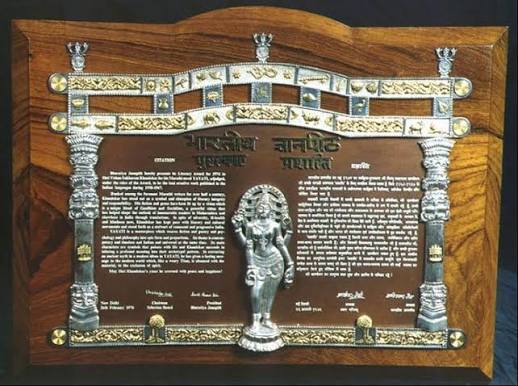
A bronze replica of Vagdevi (the Goddess Saraswati), symbolising wisdom and artistic truth
-
A formal citation detailing the writer’s literary legacy
Notable Winners Through the Decades
Since 1965, the roll call of Jnanpith laureates has read like a who’s who of modern Indian writing:
-
G. Sankara Kurup (1965, Malayalam): The very first laureate, honoured for Odakkuzhal.
-
Tarashankar Bandyopadhyay (1966, Bengali): Celebrated for his vivid chronicles of rural Bengal.
-
Kuvempu (1967, Kannada) & Umashankar Joshi (1967, Gujarati): Joint winners who defined modern poetry in their respective languages.
-
Amrita Pritam (1982, Punjabi): One of India’s most fearless literary voices, capturing the trauma and resilience of Partition.
-
U. R. Ananthamurthy (1994, Kannada): A towering novelist and public intellectual.
-
Mahasweta Devi (1996, Bengali): Honoured for her uncompromising fiction and tireless advocacy for tribal communities.
-
Amitav Ghosh (2018, English): Made history as the first English-language writer to receive the 54th Jnanpith.
-
Akkitham Achuthan Namboothiri (2019, Malayalam): Recipient of the 55th award.
-
Nilamani Phookan (2021, Assamese): Honoured with the 56th award for his modernist poetry.
-
Damodar Mauzo (2022, Konkani): Awarded the 57th Jnanpith for his sharp, empathetic storytelling.
-
Jagadguru Rambhadracharya (Sanskrit) & Gulzar (Urdu) (2023): Joint recipients of the 58th award.
-
Vinod Kumar Shukla (2024, Hindi): Celebrated for his quiet, surrealist prose and poetry (59th award).
-
R. Vairamuthu (2025, Tamil): Recipient of the 60th Jnanpith Award.
Malayalam’s Remarkable Track Record
For a relatively small state, Kerala has left an outsized mark on the Jnanpith. Six Malayalam writers have brought the Vagdevi statue home:
-
G. Sankara Kurup (1965): Set the precedent as India’s very first laureate.
-
S. K. Pottekkatt (1980): A master storyteller and travel writer whose journeys across continents enriched Malayalam prose.
-
Thakazhi Sivasankara Pillai (1984): The author of classics like Chemmeen and Kayar, famous for giving voice to Kerala’s working class.
-
M. T. Vasudevan Nair (1995): Known simply as “MT,” a giant of modern fiction and cinema who dissected the shifting dynamics of Kerala’s joint-family system.
-
O. N. V. Kurup (2007): A beloved lyricist and poet whose verses blended romanticism with deep social consciousness.
-
Akkitham Achuthan Namboothiri (2019): A poet of rare philosophical depth whose work spanned decades of social transformation.
The First Woman to Win
In 1976, Bengali novelist Ashapoorna Devi became the first woman to receive the Jnanpith Award. Writing largely from within the confines of a traditional household, she broke new ground with her famous trilogy—Pratham Pratishruti, Subarnalata, and Bakulkatha—which laid bare the quiet struggles and resilience of generations of Bengali women.
The Latest Laureate
The 60th Jnanpith Award (for 2025) was conferred upon veteran Tamil poet and lyricist R. Vairamuthu. Over a career spanning decades, Vairamuthu has bridged the gap between high literary poetry and mainstream Tamil cinema, making him only the third Tamil writer—after Akilan and Jayakanthan—to receive the honour.
Jnanpith vs. Sahitya Akademi: What’s the Difference?
People often mix up India’s two biggest literary prizes, though they serve very different purposes:
| Feature | Jnanpith Award | Sahitya Akademi Award |
| Presented By | Bharatiya Jnanpith (a private cultural trust) | Sahitya Akademi (India’s National Academy of Letters) |
| What It Honours | An author’s overall lifetime contribution | A single outstanding book published recently |
| Scope | One (occasionally two) national winner(s) per year across all languages | Separate annual awards given in 24 languages every year |
Why It Still Matters
In an era of fleeting attention spans and algorithmic reading lists, the Jnanpith Award serves a vital purpose. By shining a national spotlight on regional writers, it encourages translations, introduces readers to voices outside their own state borders, and affirms that great literature doesn’t have to be written in English—or in a major metropolis—to belong to the whole country.
Quick Facts at a Glance
-
Instituted: 1961 (First awarded in 1965)
-
First Winner: G. Sankara Kurup (Odakkuzhal, Malayalam)
-
First Woman Winner: Ashapoorna Devi (1976, Bengali)
-
First English Winner: Amitav Ghosh (2018)
-
Eligible Languages: 22 Eighth Schedule languages + English
-
Prize: ₹11 lakh, a bronze Vagdevi statue, and a citation
Common Questions
Is the Jnanpith Award given every single year? It is intended as an annual prize, though the Selection Board can skip a year if it feels no candidate meets the criteria.
Can a writer win it twice? No. It is strictly a once-in-a-lifetime recognition.
Can it be awarded posthumously? No. Under the trust’s rules, a writer must be alive when their name is considered for the award.
Literature is how a society remembers who it is—capturing its histories, anxieties, and quietest human truths. For more than six decades, the Jnanpith Award has stood as India’s highest tribute to the writers who give those experiences a permanent voice.