Top 5 hockey players in india
Trying to pick the five greatest Indian hockey players is an impossible exercise if you only look at medals. The game has simply changed too much. The grass-pitch artistry of the 1930s bears almost no physical resemblance to the hyper-athletic, tactical war played on modern wet turf.
Yet Indian hockey has always been less about systems and more about singular, era-defining talents—individuals who either kept the country at the top of the world or dragged it back up when everyone else had written it off.
Spanning nearly a century, these five figures didn’t just win; they defined the soul of Indian hockey across five distinct generations.
1. Major Dhyan Chand: The Original Standard

Long before modern sports analytics, Dhyan Chand created an aura so potent it drifted into folklore. Stories of European authorities snapping his stick to search for hidden magnets weren’t just tall tales; they were the only way rivals could make sense of a man whose stick seemed to possess gravitational pull.
Across three dominant Olympic campaigns—Amsterdam 1928, Los Angeles 1932, and Berlin 1936—Dhyan Chand was the centerpiece of a team that essentially invented attacking field hockey. In the 1936 Berlin final against Germany, played on a soaked pitch in front of a partisan crowd, he took off his spiked boots to run barefoot on the slippery grass, orchestrating an 8–1 demolition.
He didn’t just win gold; he established India’s first genuine claim to global sporting supremacy.
2. Balbir Singh Sr.: The Relentless Goal Machine

If Dhyan Chand was the artist, Balbir Singh Dosanjh was the executioner. Taking over the mantle in the immediate aftermath of Partition—a time when the country was desperately searching for identity and pride—Balbir spearheaded India’s post-independence golden run.
He played in three Olympics (London 1948, Helsinki 1952, Melbourne 1956) and left with three golds. His signature moment remains etched in Olympic history: the 1952 Helsinki final against the Netherlands, where India won 6–1. Balbir scored five of those goals, an individual record in an Olympic final that stands untouched to this day.
He was a classic center-forward—instinctive inside the circle, physically brave, and ruthlessly clinical whenever he saw daylight. Decades later, as manager of the 1975 World Cup team, he proved that his winning instincts translated seamlessly from the turf to the dugout.
3. Mohammad Shahid: Pure Street Magic on Grass
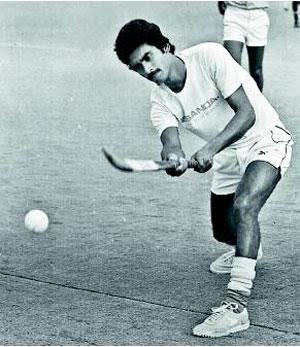
The late 1970s and 80s were turbulent times for Indian hockey. AstroTurf had arrived, systematically dismantling the subcontinent’s traditional reliance on close ball control in favor of European power, speed, and penalty-corner routines.
Yet, right in the middle of that tactical upheaval came Mohammad Shahid.
Shahid played hockey like an improvisational jazz musician. With an impossibly low center of gravity and lightning-fast wrists, he could eliminate three defenders in a phone booth, using a signature half-push and quick dodge that made international full-backs look like statues. He was instrumental in India’s gold run at the boycotted 1980 Moscow Olympics, but his real legacy was aesthetic: in an era where hockey was becoming robotic, Shahid reminded the world why people fell in love with Indian stick-work in the first place.
4. Dhanraj Pillay: Heart, Hustle, and the TV Era

By the 1990s, Indian hockey had slipped from its Olympic pedestal, but it found a solitary superstar capable of carrying the burden on his shoulders alone: Dhanraj Pillay.
Lean, explosive, and relentlessly emotional, Pillay played with an intensity that burned through television screens. Across four Olympics, four World Cups, and four Asian Games, he was the face of the sport for an entire generation. While teams game-planned specifically to foul him and shut down his space, Pillay’s raw burst of speed from deep inside his own half remained virtually unplayable.
Leading India to the 1998 Asian Games gold—breaking a painful 32-year drought—remains the emotional peak of his career. He bridged the gap between old-school romance and modern professional athleticism, refusing to let hockey fade into cricket’s shadow.
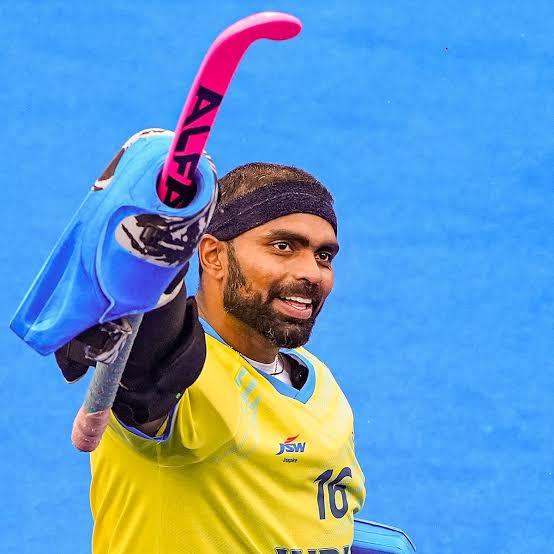
5. PR Sreejesh: The Anchor of the Renaissance
For decades, Indian hockey lived on nostalgia. Attack was celebrated; defense and goalkeeping were often treated as afterthoughts. PR Sreejesh changed that culture entirely.
As the vocal, fearless anchor of India’s backline for nearly two decades, Sreejesh didn’t just make saves—he gave the entire team the tactical freedom to attack knowing they had an elite stopper behind them. His career reached its crescendo when it mattered most: standing tall in the dying seconds of the bronze-medal match at Tokyo 2020 to end India’s 41-year Olympic medal drought, and backing it up with a heroic defensive campaign to repeat the feat in Paris 2024.
Retiring on top after Paris, Sreejesh stepped down having shifted the narrative from “remember when we used to win?” to “we expect to win again.”
The Evolution of the Game
| Player | Prime Era | Primary Role | Defining Trait |
| Major Dhyan Chand | 1920s–1930s | Inside Forward / Center | Uncanny spatial awareness & ball magnetism |
| Balbir Singh Sr. | 1940s–1950s | Center-Forward | Ruthless, clutch finishing inside the circle |
| Mohammad Shahid | 1980s | Inside Left | Dazzling close control & wrist trickery |
| Dhanraj Pillay | 1990s–2000s | Forward | Explosive straight-line speed & relentless drive |
| PR Sreejesh | 2010s–2020s | Goalkeeper | Clutch shot-stopping & defensive command |
A Century of Carrying the Flag
Generational debates in hockey are fundamentally flawed. Dhyan Chand never had to sprint across a water-sprayed artificial surface; PR Sreejesh never had to control an unpredictable leather ball on uneven turf.
What unites these five is how they met the demands of their time. Dhyan Chand conquered the world; Balbir Singh consolidated that supremacy; Shahid preserved the art when the game modernized; Pillay kept the flame burning during the lean years; and Sreejesh guarded the net to bring Indian hockey back to the Olympic podium