Top 5 football stadiums in india
A great football ground isn’t just concrete, floodlights, and plastic bucket seats. You know you’re in a real football ground when the stands shake during a derby, when thirty thousand people sing the exact same chant in unison, and when the air feels electric the moment the whistle blows.
India’s football landscape has exploded beyond the days when everything revolved around a single city. While giant multipurpose arenas in Delhi or Navi Mumbai exist on paper, raw capacity doesn’t guarantee soul. A 60,000-seat bowl running half-empty feels like a library, but an intimate, packed ground with supporters breathing down the touchline can rattle any opponent.
If you want to experience Indian football at its loudest, most historic, and most atmospheric, these five grounds stand heads above the rest.
1. Vivekananda Yuba Bharati Krirangan (Salt Lake Stadium) – Kolkata
The Cathedral of Indian Football
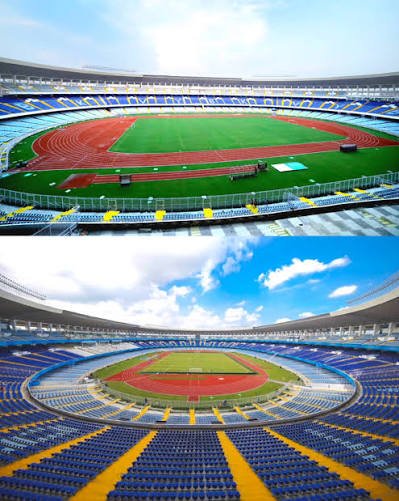
You cannot talk about football in India without starting at Salt Lake. Situated in Bidhannagar, Kolkata, this massive amphitheatre is where legends are made and heartbreaks feel catastrophic.
Even though renovations brought its old, chaotic 120,000+ capacity down to a more structured ~68,000 for football matches, stepping onto the pitch here is still an intimidating rite of passage. It is the shared battlefield of Kolkata’s legacy clubs—Mohun Bagan, East Bengal, and Mohammedan Sporting. When the Kolkata Derby (Boro Match) is on, the city essentially shuts down, splitting into rival camps of green-and-maroon and red-and-gold. The noise isn’t background chatter; it’s a deafening roar that echoes for miles.
Beyond domestic history, it remains the AIFF’s premier stage for global fixtures, hosting everything from the 2017 FIFA U-17 World Cup knockout games to blockbuster international friendlies. If you only visit one Indian stadium in your lifetime, make it this one on derby day.
2. Jawaharlal Nehru International Stadium (Kaloor) – Kochi
The Yellow Sea

If Kolkata represents Indian football’s heritage, Kochi is the roaring heart of modern fan culture.
Home to Kerala Blasters FC, the Kaloor Stadium holds around 41,000 fans, but on matchday it sounds like a hundred thousand. Hours before kickoff, the roads around Kaloor become an endless surge of yellow jerseys. The Manjappada (Yellow Army) ultras have turned this venue into one of the most hostile away trips in the Indian Super League—visiting managers openly admit the wall of whistling and chanting makes tactical communication from the sideline almost impossible.
Kochi proved its global credentials during the 2017 FIFA U-17 World Cup, packing out the stands regardless of who was playing. When the senior national team returns—like India’s 2026 AFC Asian Cup qualifying clash against Hong Kong—the stadium turns into a fortress. It is living proof that Kerala’s obsession with football isn’t just nostalgia; it’s an active, weekly religion.
3. Sree Kanteerava Stadium – Bengaluru
The West Block Fortress

The Kanteerava doesn’t boast the massive footprint of Kochi or Kolkata, seating just under 26,000. Yet pound-for-pound, it has created the most vibrant, European-style supporter culture in the country.
Anchored in the heart of Bengaluru, it is the fortress of Bengaluru FC and the legendary “West Block Blues.” The atmosphere here isn’t just noise; it’s orchestrated banter, massive tifos, and relentless singing that lasts straight through the 90 minutes.
The stadium also holds sacred memories for the national team. From the historic 1–0 World Cup qualifying upset against UAE back in 2001 to lifting the SAFF Championship trophy amidst pouring rain in 2023, Kanteerava brings a rare, intimate energy where fans are right on top of the action. It proves that you don’t need 80,000 seats to make a ground feel legendary.
4. Pandit Jawaharlal Nehru Stadium (Fatorda) – Goa
The Coastal Football Capital

Fatorda Stadium in Margao might top out around 19,000 capacity, but it punches well above its weight class. Goa has football in its DNA, and Fatorda has been the state’s nerve centre for decades.
Home to FC Goa, the ground is famous for having one of the slickest, best-maintained playing surfaces in South Asia, encouraging the quick, technical, possession-heavy style Goan teams are loved for. Because of its pitch quality, modern lighting, and compact acoustics, Fatorda has been the neutral venue of choice for multiple ISL finals and marquee continental fixtures.
On a Saturday night under the lights, with brass bands playing in the stands and a sea of orange cheering every touch, Fatorda offers an authentic footballing afternoon you won’t find anywhere else in the country.
5. Kalinga Stadium – Bhubaneswar
The Model for Modern Indian Sport
A decade ago, Bhubaneswar wasn’t on the football map. Today, Kalinga Stadium is a testament to what happens when state-of-the-art infrastructure meets proactive planning.
Seating roughly 15,000 spectators, Kalinga doesn’t rely on century-old legacy. Instead, it offers world-class facilities: top-tier turf, modern player amenities, high-performance training pitches, and pristine broadcast setups. It quickly became an indispensable home base for the national teams—hosting the Intercontinental Cup, the AIFF Gold Cup, India U-20 clashes, and top-tier ISL action with Odisha FC.
Kalinga earns its spot because it bridges the gap between old-school passion and the professional, sports-science-driven standard Indian football desperately needs moving forward.
Beyond the Seat Count
Too often, people rank stadiums by sheer size, leaving you with sterile athletic tracks where spectators sit a mile away from the grass. The magic of these five venues comes down to identity:
-
Kolkata gives you raw, unforgiving tradition.
-
Kochi gives you overwhelming, emotional volume.
-
Bengaluru gives you organized, modern supporter culture.
-
Goa gives you rhythm, heritage, and pure technical football.
-
Bhubaneswar gives you the blueprint for the game’s future.
Indian football has plenty of work left to do on the pitch, but standing in any of these five grounds when a late winner hits the back of the net, there’s no doubt the sport has found its home.