Anji khad bridge – india’s first cable-stayed railway bridge: a remarkable engineering marvel in jammu and kashmir
Laying train tracks through the young, fractured mountains of the Himalayas is arguably one of the most punishing civil engineering tasks in the world. Building the Katra–Banihal stretch of the Udhampur–Srinagar–Baramulla Rail Link (USBRL) meant punching through brittle rock, surviving flash floods, and bridging vertiginous gorges.
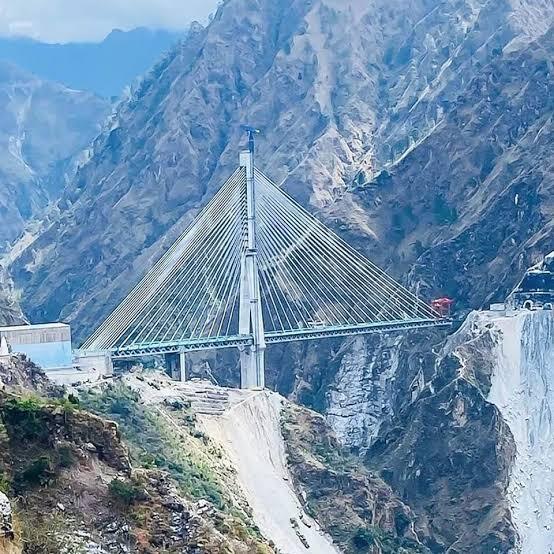
The crown jewel of that effort often gets stolen by the record-breaking arch of the nearby Chenab Bridge, but just a few kilometers away sits a structurally rarer triumph: Anji Khad Bridge—India’s first-ever cable-stayed railway bridge.
The Numbers at a Glance
| Feature | Specification |
| Bridge Type | Asymmetrical single-pylon cable-stayed railway bridge |
| Location | Reasi district, Jammu & Kashmir (connecting Katra and Reasi) |
| Total Length | 725 m (Cable-stayed section: 473.25 m; Main span: 290 m) |
| Deck Clearance | ~331 m above the riverbed |
| Main Pylon Height | 193 m above foundation level |
| Cable System | 96 high-tensile stay cables (~653 km of wire strands combined) |
| Structural Steel | Over 8,200 metric tonnes |
| Project Cost | ~₹580 crore |
| Design Partner | Italferr (Italian State Railways / FS Group) |
Why a Cable-Stayed Bridge in a Himalayan Gorge?
Initial plans didn’t call for a cable-stayed structure. The original design leaned toward a traditional arch similar to the Chenab Bridge. However, geological surveys of the Anji Khad ravine quickly scrapped that idea:
-
Treacherous Geology: The slopes of the Anji gorge consist of loose hill-wash debris, massive shifting limestone boulders, and fractured cherty rock. Building heavy arch abutments on both sides posed an unacceptable landslide and subsidence risk.
-
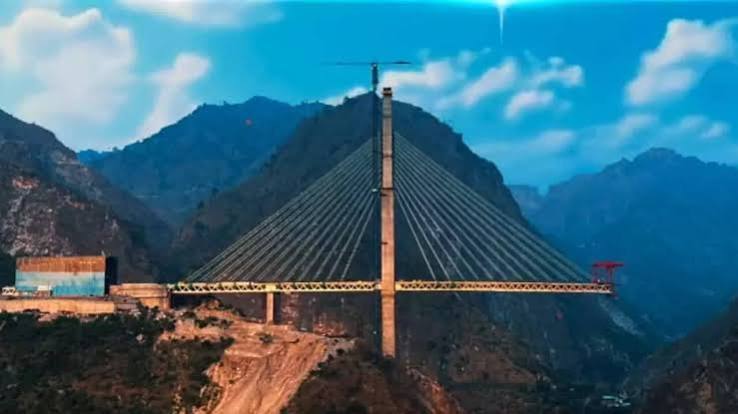
The Asymmetric Solution: Engineers realized they couldn’t safely anchor piers across the riverbed or on both slopes. The solution was an asymmetrical setup: plant a massive central foundation on the firmer Katra-side bank, erect a single 193-meter pylon, and balance the 290-meter main span entirely via tension cables suspended across the void.
-
High-Altitude Aerodynamics: Gale-force winds routinely funnel through deep Himalayan valleys. The bridge deck was aerodynamically profiled to prevent vortex shedding and flutter, keeping track alignment rigid enough for high-speed train movements.
How the Engineering Works
A rail bridge absorbs violently different dynamic loads than a highway bridge. Where cars distribute weight relatively evenly, a freight train or multi-coach rake hits the deck with thousands of tonnes of concentrated, rolling mass.
-
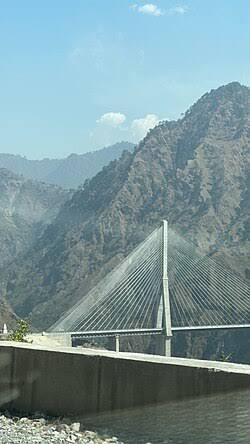
The 96-Cable Web: The track deck is suspended by 96 specialized stay cables fanning out from the central pylon. Each cable strand is galvanized, greased, and sheathed in high-density polyethylene to survive freezing Himalayan winters and monsoon humidity.
-
Real-Time Health Monitoring: Embedded throughout the pylon and stay cables is a network of structural sensors. These feed real-time data on cable tension, seismic vibrations, wind speed, and thermal expansion directly to maintenance control rooms.
-
Massive Slope Anchoring: Before the bridge could stand, engineers had to secure the surrounding mountain. Thousands of soil nails, pre-stressed rock anchors, and heavy shotcrete micropiles were drilled into the unstable cliff faces to lock the hillsides in place permanently.
Why It Matters for the Valley
For decades, the road link connecting Jammu to Srinagar through the Pir Panjal range has been notoriously vulnerable to landslides, blizzards, and seasonal closures.
Anji Khad Bridge completes a critical, non-negotiable gap in the all-weather railway corridor connecting the Kashmir Valley with the rest of India’s broad-gauge rail network. Beyond cutting transit hours down to reliable, weather-proof minutes for passengers and essential freight, it proves that Indian Railways can engineer its way through some of the most unforgiving terrain on the planet.