Top 5 induction stove brands in india
Whether you’re tired of refilling LPG cylinders, dealing with a cramped kitchen, or just want water to boil in under two minutes, an induction cooktop is one of the most sensible upgrades you can make.
Instead of an open flame heating the air around your vessel, induction uses electromagnetic fields to heat the pan directly. The result? Faster cooking, less wasted heat, and a kitchen that doesn’t turn into a sauna in the middle of summer.
If you’ve browsed online recently, you already know the market is flooded with options. Here is a grounded look at the top five induction cooktop brands in India right now, how they actually differ, and what you need to check before buying one.
The Top 5 Brands: Which One Fits Your Routine?
1. Prestige: The Safe, Reliable All-Rounder
Prestige dominates Indian kitchens for good reason—they build appliances specifically for how we cook.
-
The Standout: The Prestige PIC series (especially models around 1600W to 1900W) has been a kitchen staple for years.
-
Why It Works: Prestige excels at Indian presets. One tap sets the heat profile for dal, chapati, pressure cooking, or deep frying. Many models also include built-in voltage regulators, which is a lifesaver if your area experiences sudden power spikes.
-
Best For: Families wanting a dependable, no-fuss daily driver with plenty of service centers nationwide.
2. Philips: High Power and Sleek Design

Philips treats induction cooktops less like basic hotplates and more like precision culinary gear.
-
The Standout: The Philips Viva Collection HD4928/01 (2100W) remains one of the most popular high-output units on the market.
-
Why It Works: If you hate waiting for a large pot of water or milk to boil, the extra punch of a 2100W unit makes an immediate difference. The glass tops are durable, the digital controls are responsive, and the heat distribution is remarkably even.
-
Best For: Anyone prioritizing speed, heavy-duty cooking, and a clean, modern aesthetic.
3. Pigeon by Stovekraft: The Budget Champion

Pigeon proves you don’t need to drop a small fortune just to cook without gas.
-
The Standout: The Pigeon Cruise 1800W is routinely one of the best-selling budget cooktops in the country.
-
Why It Works: It gives you solid wattage (1800W is plenty for everyday tadka, sabzi, and boiling) at a fraction of the cost of premium competitors. The controls are simple push-buttons that hold up well against greasy fingers.
-
Best For: Students, bachelors, or anyone who just wants a cheap, reliable backup stove when the gas cylinder runs dry.
4. Havells: Premium Build and Smart Controls
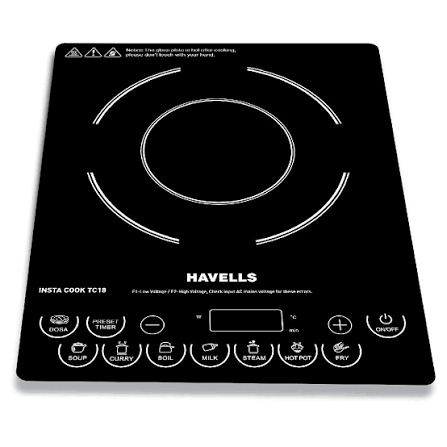
Havells brings its electrical engineering background into the kitchen, focusing heavily on safety components and build quality.
-
The Standout: Their mid-to-high wattage touch-panel models.
-
Why It Works: Havells units tend to feature better thermal management, meaning the internal cooling fans run quieter and the electronics last longer. (Note: Double-check that you’re buying an induction stove and not an infrared cooktop—Havells makes both, and infrared uses a completely different radiant-heat mechanism).
-
Best For: Modular kitchens where you want sleek touch panels and robust internal electrical safety.
5. Usha: Simple, Sturdy, and Functional

Usha focuses on straightforward utility without burying you in menus you’ll never touch.
-
The Standout: The Usha Cook Joy line (typically 1600W).
-
Why It Works: At 1600W, these units don’t draw massive power spikes, making them very gentle on home wiring and smaller inverters while still getting everyday meals cooked without fuss. The interface is intuitive enough that even elderly family members can use it without a manual.
-
Best For: Small households, couples, and anyone who prefers basic, durable buttons over complex digital menus.
Quick Brand Comparison
| Brand | Sweet-Spot Wattage | Best Known For | Who It’s Best For |
| Prestige | 1600W – 2000W | Tailored Indian presets & voltage surge protection | Everyday family cooking |
| Philips | 2100W | High-heat performance and premium build | Fast, heavy-duty cooking |
| Pigeon | 1800W | Incredible value for money | Students, bachelors, backup stove |
| Havells | 1900W – 2100W | Contemporary styling and advanced safety circuits | Modern modular setups |
| Usha | 1600W | Straightforward interface and compact sizing | Small households & simple meals |
How to Pick the Right One (Without Overthinking It)
Before hitting “Buy Now,” run through this quick checklist:
-
Wattage vs. Reality:
-
1600W to 1800W: The sweet spot for 80% of homes. Perfect for dal, rice, boiling milk, and daily curries.
-
2000W to 2200W: Choose this if you cook in large volumes, do lots of deep frying, or simply hate waiting for pots to boil.
-
-
The Magnet Test: Induction only works with cookware that contains magnetic iron. Run a fridge magnet over the bottom of your pots and pans. If it snaps on firmly, it works. If it slides off (pure copper, bare aluminum, traditional clay, or glass), the stove won’t even turn on.
-
Buttons vs. Touch Panels:
-
Push-buttons: Mechanical, tactile, and easier to press if your hands are wet or oily.
-
Touch sensors: Look far sleeker and are effortless to wipe down since there are no crevices for spilled gravy to hide in.
-
-
Crucial Safety Features: Don’t buy a model unless it explicitly features auto-pan detection (it shuts off the moment you lift the pan) and overheat protection (it powers down if a dry pan starts smoking). If your neighborhood has irregular power, prioritize models with built-in high/low voltage cutoffs.
The Realistic Setup: Induction + Gas
You don’t have to throw away your gas stove. In fact, most Indian households run best on a hybrid setup: keep a two-burner gas stove for round-bottom kadhai cooking, roasting rotis directly on the flame, or dealing with power cuts—and let a 1800W–2100W induction cooktop handle the heavy daily lifting of boiling, pressure cooking, and one-pot meals.