
Top 5 mixer grinders in india
Buying a mixer grinder in India is deceptively tricky. Walk into an appliance store or scroll through Amazon, and you’re instantly hit with a wall of numbers: 500W, 750W, 1000W, turbo motors, food-processor attachments, and wildly varying price tags.
A lot of buyers make the mistake of assuming higher wattage automatically means a better machine. In reality, a heavy 1000W workhorse is complete overkill if you just need coconut chutney on weekends, while a basic 500W model will overheat the second you throw unsoaked raw turmeric or thick urad dal batter at it.
To save you the headache, here is a breakdown of five proven mixer grinders suited for different cooking styles, family sizes, and budgets.
Quick Comparison
| Model | Motor Power | Approx. Price | Best For |
| Bajaj Rex | 500W | ₹2,000 – ₹3,500 | Small households, basic daily grinding on a budget |
| Philips HL7707 | 750W | ₹4,000 – ₹6,000 | The daily sweet spot for most family kitchens |
| Preethi Zodiac | 750W | ₹6,000 – ₹9,000 | All-in-one meal prep (kneading, chopping, slicing) |
| Sujata Dynamix | 900W | ₹5,000 – ₹7,000 | Raw power, continuous running, and hard masalas |
| Joyonn Veloce | 1000W | ₹3,500 – ₹5,500 | Heavy batters and large batches at an entry price |
The 5 Best Mixer Grinders Reviewed
1. Philips HL7707 (750W) – The Reliable Everyday Workhorse

If you aren’t running a catering business and just want a solid, no-nonsense machine for regular Indian cooking, start here. 750W is the sweet spot: it powers through coconut, ginger-garlic paste, and dry garam masalas without breaking a sweat. The jars seal tight, the build is compact enough to live on your counter, and Philips’ service network across India means replacement gaskets and couplers are easy to find.
-
Get this if: You want a dependable daily driver for a family of 3 to 5.
2. Sujata Dynamix (900W) – The Heavy-Duty Powerhouse
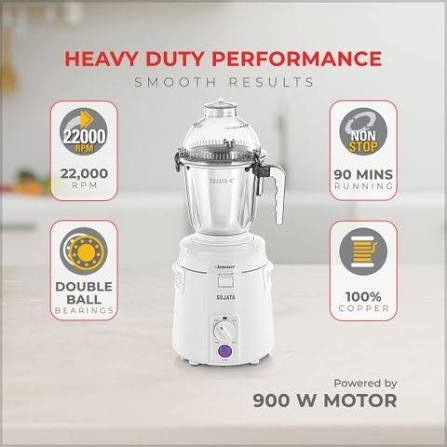
Ask any juice shop or commercial snack counter what they run, and it’s almost always a Sujata. The aesthetics look like they haven’t changed since 1995, but mechanically, they’re practically indestructible. The 900W motor runs at breakneck speeds and handles 20 to 90 minutes of continuous running without tripping the overload switch.
-
Get this if: You grind rock-hard spices, make thick idli batter weekly, and care far more about raw durability than sleek looks.
3. Preethi Zodiac (750W) – The Meal-Prep Multitasker

If you hate chopping vegetables and kneading roti dough by hand, the Zodiac earns its counter space. Alongside standard stainless-steel grinding jars, it includes a food-processor master chef jar that chops onions, slices veggies, extracts citrus juice, and kneads atta in under two minutes.
-
Get this if: You want one appliance to handle 80% of daily meal prep, not just pure grinding.
4. Joyonn Veloce (1000W) – Maximum Power on a Budget

Getting a true 1000W copper-wound motor under ₹5,000 is rare. The Veloce brute-forces its way through heavy grinding tasks, dense batters, and large quantities of whole spices with minimal resistance. It’s loud, but it cuts down running time significantly.
-
Get this if: You regularly cook in bulk, have a large family, and want high wattage without paying premium tier prices.
5. Bajaj Rex (500W) – The No-Frills Budget Pick
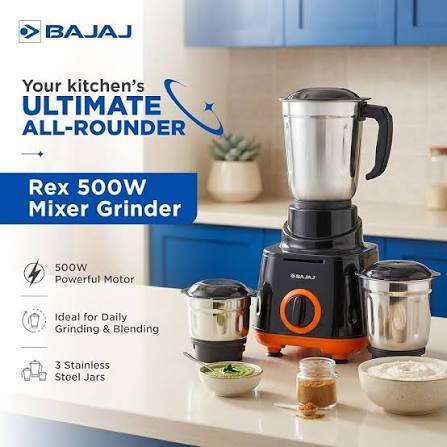
You don’t need an industrial motor for two green chilies and a handful of coriander. The Bajaj Rex is cheap, compact, and perfectly fine for bachelor pads, students, or couples who rarely cook elaborate meals. It handles daily chutneys, ginger-garlic paste, and tomato purees fine—just don’t expect it to grind hard lentils or whole dry turmeric without straining.
-
Get this if: You have simple kitchen needs, limited counter space, and a tight budget.
Wattage Reality Check: 500W vs. 750W vs. 1000W
-
500W: Strictly for light wet grinding and fine powders in small batches. Prone to heating up if run continuously for more than 3–4 minutes.
-
750W: The standard for standard Indian households. Handles 90% of tasks, including idli/dosa batter, soaked dals, and whole roasted spices.
-
900W–1000W: For large joint families, frequent commercial-style meal prep, or grinding dry, unroasted, fibrous ingredients in heavy quantities.
What to Check Before Buying
-
Jar Couplers & Locks: The plastic or rubber teeth under the jar take the brunt of the motor’s torque. Look for thick, reinforced couplers and jars that twist firmly into the base without wobbling.
-
Blade Geometry: Flat blades work best for dry grinding, while multi-pronged, curved blades create the vortex required to blend wet pastes evenly without leaving rogue chunks.
-
Reset Switch / Overload Protection: Essential for Indian kitchens. If you overload a jar, the machine should trip a fuse button on the bottom instead of frying the motor.
-
Ventilation: Higher wattage generates serious heat. Ensure the base has elevated rubber feet and unobstructed bottom vents so the motor cools efficiently during long runs.
If you’re still on the fence, a 750W model (like the Philips or Preethi) handles standard home cooking with the least amount of friction. Step down to 500W only if budget or counter space is tight, and step up to 900W+ only if thick batters and tough spices are a daily reality in your kitchen.

